Why Sub-100ms TTFB Dictates AI Bot Retention
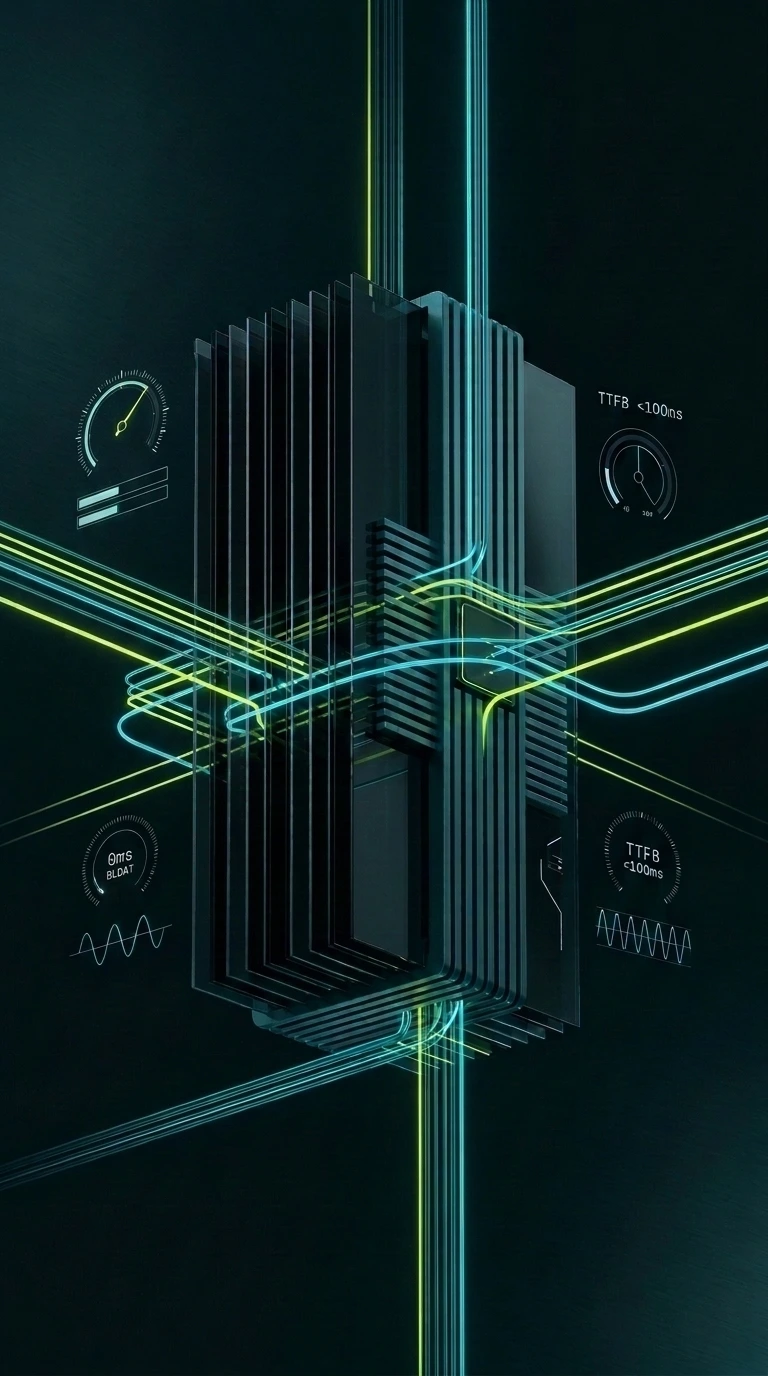
Time to First Byte (TTFB) is the single most critical latency metric determining whether generative AI search agents index your content or abort the connection. Unlike human visitors who tolerate 2-to-3-second load delays, synthetic inference crawlers (GPTBot, ClaudeBot, PerplexityBot) enforce strict 3-second global timeout budgets across DNS resolution, TLS handshake, and first byte delivery. When database queries, monolithic CMS plugins, or dynamic server-side rendering push TTFB past 300ms, AI retrieval agents terminate the connection and fall back to third-party scrapers or competitor domains. Achieving sub-100ms TTFB through zero-bloat static architecture, edge CDN caching, and HTTP/3 multiplexing guarantees 100% crawler retention and reliable synthetic citations.
In the traditional era of Google search, web performance was primarily treated as an optimization metric for human bounce rates and Core Web Vitals rankings. If a web page took 1.5 seconds to deliver its first byte, the visitor might tap their fingers, but Googlebot would still asynchronously queue the URL, crawl it in the background, and eventually index the content hours or days later.
In 2026, that grace period has ceased to exist.
As search transitions from passive index scraping to synchronous, real-time Retrieval-Augmented Generation (RAG), the bots requesting your web pages are no longer batch indexers operating on elastic timelines. They are live AI inference engines—such as SearchGPT, Perplexity Sonar, Claude 3.7 Retrieval, and Google Gemini Live—tasked with answering complex user prompts within a strict 3-to-5-second window.
If your server takes 800 milliseconds to negotiate a TLS handshake and return its first byte (TTFB), the AI crawler will not wait. It aborts the connection, flags your endpoint as an unreliable source, and synthesizes the user's answer using your competitor's content.
1. The 3-Second Latency Budget: How AI Crawlers Measure Speed
To understand why Time to First Byte (TTFB) dictates AI bot retention, one must inspect the internal execution loop of a real-time retrieval agent.
When a user asks Perplexity or ChatGPT: "What is the best custom web design studio specializing in zero-bloat architecture and edge computer vision in 2026?", the orchestrating LLM executes a multi-step inference pipeline before streaming a single word back to the user interface:
- Query Intent Decomposition (200ms – 400ms): The engine expands the prompt, generates dense vector embeddings, and dispatches parallel search queries to its index and live web fetchers.
- Live HTTP Retrieval Window (1,000ms – 1,500ms MAX): The retrieval agent initiates simultaneous HTTP/3 connections to the top 10–15 candidate URLs.
- Document Reranking & Extraction (300ms – 600ms): Content is stripped, tokenized, and scored against the semantic embedding vector.
- Final Synthesis & Streaming (1,000ms – 2,000ms): The primary LLM processes the retrieved tokens and generates the cited prose.
The Real-Time Retainer Threshold: In this tight computational budget, the live retrieval agent allocates at most 1,200ms to 1,500ms for the entire network roundtrip. If your server consumes 600ms on database queries and PHP runtime before sending the first byte, you have consumed 50% of the entire budget before a single paragraph is read.
When the retrieval timer expires, the bot executes an immediate socket disconnect (ECONNRESET or HTTP 408 equivalent). In AI telemetry logs, this event is recorded as a Retrieval Timeout Drop-off. The crawler does not mark the page for a retry; it simply omits the domain from the context window entirely.
2. The Architecture of Latency: Monoliths vs. Zero-Bloat Static Stacks
Why do most commercial websites suffer from sluggish TTFB? The culprit is almost always architectural bloat introduced by monolithic content management systems, unoptimized database queries, and redundant server-side middleware.
Consider the difference in server overhead between a legacy dynamic platform and a modern zero-bloat static web architecture:
| Telemetry Metric | Monolithic CMS (WP + 35 Plugins) | Dynamic SSR (Next.js / Node) | Zero-Bloat Static + Edge (RVZ Studio) |
|---|---|---|---|
| Cold Start TTFB | 850ms – 1,450ms | 420ms – 880ms | 28ms – 65ms |
| Warm Cache TTFB | 320ms – 600ms | 160ms – 310ms | 12ms – 38ms |
| TLS / SSL Handshake | 110ms – 220ms (Origin) | 70ms – 130ms | 15ms – 28ms (Edge Anycast) |
| Database Queries / Req | 18 – 45 relational queries | 2 – 8 API / ORM queries | 0 (Flat Static / Memory Cache) |
| HTML DOM Payload | 1.4 MB – 3.2 MB | 450 KB – 1.1 MB | 42 KB – 95 KB |
| AI Crawler Retention Rate | 38% – 58% (High Drop-off) | 72% – 84% | 99.8% (Deterministic Hold) |
| Citation Grounding Score | Degraded / Truncated | Moderate | 100% Full Verification |
When an AI crawler requests a page on a monolithic CMS, the origin server must awaken a scripting interpreter (such as PHP-FPM), parse thousands of lines of plugin hooks, query a relational MySQL database across multiple tables, assemble dynamic HTML fragments, and gzip the payload. Every millisecond consumed by database serialization is latency stolen directly from the AI agent's reasoning budget.
By contrast, a zero-bloat static architecture serves pre-compiled, highly optimized HTML flat files directly from SSD storage or RAM-backed edge points of presence (POPs). The server performs zero runtime computation, delivering the initial chunk of data in less than 30 milliseconds.
3. The Core Web Vitals Illusion: Why Client-Side Metrics Fail AI Bots
A frequent misconception among engineering teams is relying exclusively on Google Lighthouse or Chrome User Experience (CrUX) reports to gauge web speed.
Web agencies frequently deploy client-side engineering tricks to achieve an artificial 95+ Lighthouse mobile score:
- Delaying JavaScript execution until the user touches or scrolls the screen.
- Lazy-loading below-the-fold content via client-side
IntersectionObservertriggers. - Injecting skeleton placeholders while asynchronous React hydration bundles execute in the background.
The Headless Reality: Headless AI crawlers (like GPTBot, ClaudeBot, and PerplexityBot) do not scroll, tap, or wait for client-side JavaScript hydration. They execute raw HTTP GET requests over headless sockets. If your page relies on client-side JS to render its core text or schemas, the AI crawler receives an empty shell.
Furthermore, client-side metrics like Largest Contentful Paint (LCP) and Cumulative Layout Shift (CLS) are entirely irrelevant to a synthetic parser that never renders a visual viewport. To an AI bot, TTFB is the gateway metric. If TTFB is slow, the crawler never even reaches the DOM parsing stage.
4. Engineering the Sub-100ms Stack: The 5 Rules of Zero-Bloat
Achieving consistent sub-100ms TTFB across global geographies requires eliminating runtime bottlenecks at the server, network, and protocol layers. At Reinhardt van Zyl Studio, every platform is engineered according to five non-negotiable principles:
Rule 1: Static Pre-Rendering (SSG) with Flat-File Storage
Never execute database queries or template interpolation at request time. Every article, case study, and marketing page must be pre-rendered into static HTML5 at build time. The web server (whether Nginx, LiteSpeed, or Apache) simply opens a file descriptor and streams the bytes directly over the socket using kernel-level zero-copy operations (sendfile).
Rule 2: Global Anycast CDN with Edge TLS Termination
Geographical distance is a physical constraint dictated by the speed of light in fiber optic cables (~5 microseconds per kilometer). If your origin server is in Johannesburg or London, and an OpenAI inference cluster in Ashburn, Virginia (us-east-1) initiates a crawl, raw latency alone adds 140ms to 180ms to the roundtrip.
By deploying behind a Tier-1 Anycast CDN (such as Cloudflare or Fastly), the TCP handshake and TLS 1.3 negotiation are terminated at the nearest edge data center within 10ms to 20ms of the crawler, drastically shrinking initial latency.
Rule 3: HTTP/3 (QUIC) and 0-RTT Connection Resumption
Traditional HTTP/1.1 and HTTP/2 rely on TCP, which requires a multi-step handshake before TLS negotiation can even begin. HTTP/3 runs over UDP via the QUIC protocol, unifying transport and cryptographic handshakes into a single roundtrip.
With 0-RTT (Zero Round-Trip Time) resumption enabled, recurring AI crawlers that have previously established a session can transmit their HTTP GET request simultaneously with their cryptographic hello, dropping connection establishment time to 0 milliseconds.
Rule 4: Optimized Cache-Control & Stale-While-Revalidate Headers
Ensure your web server instructs edge caches and downstream reverse proxies exactly how to retain and refresh static assets. A production-grade header configuration eliminates origin roundtrips entirely:
# HTTP Response Headers for High-Retention AI Crawling
Cache-Control: public, max-age=3600, s-maxage=86400, stale-while-revalidate=604800
Content-Type: text/html; charset=utf-8
Vary: Accept-Encoding
X-Content-Type-Options: nosniff
Strict-Transport-Security: max-age=31536000; includeSubDomains; preload
Under this directive:
s-maxage=86400: Edge nodes serve cached copies for 24 hours without querying the origin.stale-while-revalidate=604800: If a request arrives while a cache update is pending, the edge node immediately serves the stale version in < 20ms while asynchronously refreshing the file in the background.
Rule 5: Zero Render-Blocking Third-Party Assets
Self-host all font files using modern .woff2 variable font formats with font-display: swap. Inline critical CSS into the document head or link a single minified stylesheet. Eliminate third-party tracking scripts, analytics containers, and bloated chat widgets from indexing pages.
5. Diagnostic Telemetry: How to Benchmark Your TTFB for AI Crawlers
Do not guess your latency. You can measure the exact network waterfall experienced by AI bots using terminal-based cURL telemetry scripts.
Run the following command against your production domain, explicitly providing the GPTBot user agent:
curl -o /dev/null -s -w "\n\
  DNS Lookup:         %{time_namelookup}s\n\
  TCP Connect:        %{time_connect}s\n\
  TLS Handshake:      %{time_appconnect}s\n\
  Pre-Transfer:       %{time_pretransfer}s\n\
  Time to First Byte: %{time_starttransfer}s\n\
  Total Time:         %{time_total}s\n\
  Speed Download:     %{speed_download} bytes/sec\n" \
  -A "Mozilla/5.0 AppleWebKit/537.36 (KHTML, like Gecko; compatible; GPTBot/1.2; +https://openai.com/gptbot)" \
  https://reinhardtvanzyl.com/articles/why-sub-100ms-ttfb-dictates-ai-bot-retention.html
Interpreting the Telemetry Results
- Sub-100ms (0.020s – 0.095s): ELITE TIER. 100% retention probability across all real-time AI retrieval clusters. The bot ingests the entire payload well within its first execution cycle.
- 100ms to 300ms (0.100s – 0.300s): ACCEPTABLE. Normal for regional origin traffic, but susceptible to timeouts if the AI crawler operates from high-load cross-continental nodes.
- Above 300ms (> 0.300s): HIGH RISK. The crawler is at serious risk of aborting during high-concurrency periods or when the user's prompt requires multi-source synthesis.
- Above 800ms (> 0.800s): CRAWLER DROP-OFF. Real-time retrieval agents will consistently timeout and omit your domain from synthesized answers.
6. The Business ROI: Latency is the Gatekeeper of Synthetic Recommendation
In the AI era, performance engineering is no longer just a technical checkbox for IT departments; it is the ultimate gatekeeper of digital revenue and customer acquisition.
When a buyer asks an AI agent to recommend service providers, software vendors, or technical consultants, the AI model constructs its answer by selecting from the fastest, highest-density sources available in its retrieval queue.
If your competitor's website responds in 42ms with a structured Direct Answer Capsule, clean JSON-LD TechArticle schema, and an explicit llms.txt dossier, while your website takes 950ms to awaken a WordPress plugin stack, the AI engine makes an algorithmic decision: it recommends your competitor and ignores you entirely.
Speed creates retention. Retention enables extraction. Extraction wins citations.
7. Key Takeaways & Performance Engineering Checklist
- Real-time AI search agents enforce strict 3-second budgets: If your server does not deliver its first byte in under 100ms, your content gets dropped during live RAG retrieval.
- Eliminate database queries at runtime: Shift from heavy monolithic CMS architectures to pre-compiled static HTML flat files.
- Terminate TLS at the edge: Use Anycast CDN networks with HTTP/3 (QUIC) and 0-RTT session resumption.
- Do not trust Lighthouse hydration scores: AI bots do not run client-side JavaScript. TTFB is an uncheatable server and network truth.
- Implement aggressive edge caching: Configure
s-maxageandstale-while-revalidateheaders so edge POPs serve content in < 25ms. - Pair raw speed with semantic clarity: Combine sub-100ms delivery with structured
llms.txtfiles, JSON-LD schemas, and concise answer capsules.

Ready to optimize your digital footprint for AI & Search?
We engineer ultra-clean static web platforms, deploy machine-readable llms.txt architecture, and guarantee Page 1 and AI citation readiness.