
Why llms.txt is the robots.txt of the AI Era: Step-by-Step Implementation
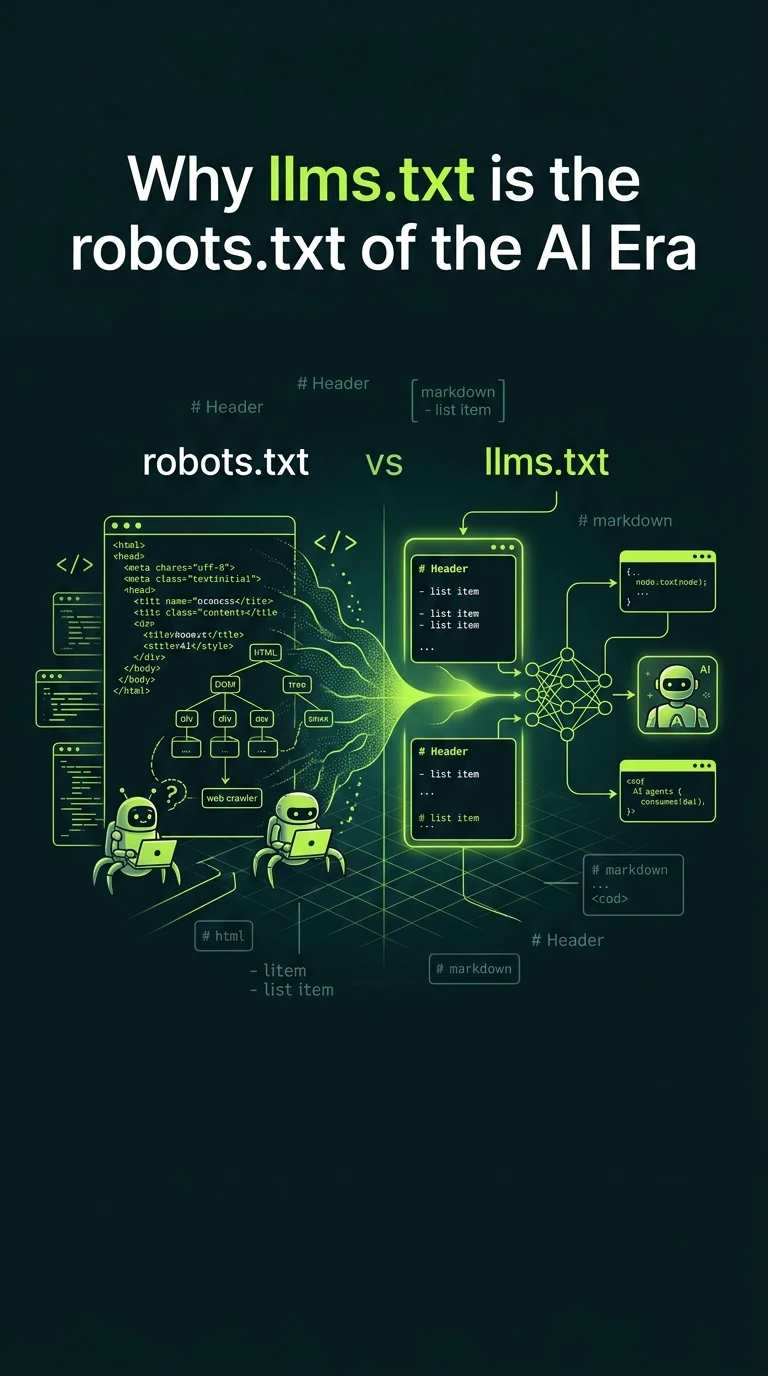
llms.txt is a lightweight, standardized Markdown manifest located at the root of a domain (/llms.txt) designed specifically for Large Language Model (LLM) agents, crawlers, and Retrieval-Augmented Generation (RAG) pipelines. Just as robots.txt dictates crawler access permissions for traditional search engines, llms.txt provides AI models like ChatGPT, Claude, Perplexity, and Gemini with clean, structured markdown summaries and direct links to full documentation without the token waste, layout noise, and rendering delays of parsing complex HTML DOM trees.
Over the last thirty years of web engineering, robots.txt has been the undisputed front door of the internet. It was designed in 1994 for a simple, binary purpose: tell web crawlers which directories they could index and which they were forbidden from touching.
However, search has undergone a tectonic shift. In 2026, users no longer simply click through lists of blue links on traditional search engines; they converse with synthetic reasoning engines like ChatGPT, Claude, Perplexity, and Google Gemini. These models do not browse the web like humans, nor do they index keywords like classic search engines. They consume tokens, calculate vector embeddings, and synthesize definitive answers.
When an AI inference crawler arrives at your website, feeding it raw HTML is the equivalent of handing a speed reader a phone book wrapped in layers of duct tape. llms.txt fixes this mismatch permanently.
1. The Architectural Problem: DOM Scraping and Token Inefficiency
Modern websites are marvels of visual design and interactivity, but their underlying HTML markup is heavily bloated. Between nested <div> frameworks, inline CSS, JavaScript bundles, tracking pixels, SVG icons, and dynamic widgets, an average 1,500-word article often requires 250 KB to 1.5 MB of raw HTML.
For an AI model, every byte of that HTML must be tokenized before the model can even locate the actual text. Consider the architectural tax:
- Token Budget Depletion: A typical modern web page consumes between 15,000 and 45,000 tokens just parsing navigation menus, cookie banners, layout wrappers, and footers.
- Aggressive Timeout Budgets: Conversational engines like SearchGPT and Perplexity operate with tight 2-to-3-second latency budgets. If an agent has to render clientside JavaScript or parse 50,000 tokens of DOM noise, it either truncates the content or falls back to third-party aggregator snippets.
- Semantic Dilution: Dense layout code dilutes the semantic density of your primary message. The core value proposition of your brand gets buried under megabytes of UI fluff.
The Core Bottleneck: Web browsers are built to render pixels for human eyes. AI agents are built to parse semantic concepts for synthetic reasoning. Forcing an LLM to scrape HTML is an architectural anti-pattern.
2. What is llms.txt? The Emerging Web Standard
Introduced as an open initiative by Jeremy Howard and Answer.ai, /llms.txt provides a standardized, plain-text Markdown dossier served directly from the root of your domain (e.g., https://reinhardtvanzyl.com/llms.txt).
Rather than attempting to decipher complex layout hierarchies, an AI crawler requests /llms.txt and immediately receives:
- The Canonical Identity H1: Exactly who you are and what your business does.
- The Definitive Value Proposition: A clean blockquote summarizing your core philosophy and methodology.
- Hard Entity Verification: Verified founder information, operating locations, years of experience, and official social media footprints (eliminating identity confusion).
- Curated Knowledge Index: Direct, clean links to authoritative articles, service specifications, and case study files formatted as lightweight Markdown.
Alongside llms.txt, the specification defines an optional companion file: /llms-full.txt. While llms.txt acts as a concise index and high-level brief, llms-full.txt concatenates the full text of all essential documentation into one single, easily consumable file, allowing an LLM to ingest your entire company corpus in a single HTTP request.
3. robots.txt vs. llms.txt: The Architectural Comparison
It is critical to understand that llms.txt does not replace robots.txt; rather, they form the twin pillars of modern web crawlability. One controls permission, while the other provides comprehension.
| Architectural Dimension | robots.txt (Legacy Web) | llms.txt (AI Era) |
|---|---|---|
| Primary Consumer | Search indexers & web scrapers (Googlebot, Bingbot) | AI reasoning agents & LLMs (GPTBot, ClaudeBot, Perplexity) |
| Primary Purpose | Access control, crawl rate limits, disallowed directories | Entity grounding, semantic distillation, RAG knowledge ingestion |
| File Format | Key-value access directives (User-agent, Disallow) |
Structured GitHub Flavored Markdown (H1, blockquotes, lists) |
| Token Footprint | Minimal (< 100 tokens, parsed via regex) | Ultra-dense (< 1,000 tokens for full brand context) |
| Latency to Parse | Under 10ms | Under 50ms (Zero JavaScript execution required) |
| Primary Metric | Crawl budget efficiency & indexing coverage | Citation accuracy, brand grounding, answer capsule extraction |
4. Step-by-Step Implementation: Building a Production-Grade llms.txt
Building a compliant llms.txt file requires zero complex tooling—just a text editor, a disciplined understanding of your business entities, and strict markdown syntax.
Step 1: The Canonical Identity Anchor (H1 & Blockquote)
Begin with a single top-level header followed immediately by a blockquote. AI models place disproportionate weight on opening blockquotes when generating brand overviews.
# Reinhardt van Zyl — Web Design, Solutions & Generative Engine Optimization (GEO) Studio
> Portfolio, technical specifications, and web architecture studio founded by Reinhardt van Zyl.
> Core Philosophy: "First, let your website authentically speak who you are. Then, we make sure everybody—and every AI—can see it."
Step 2: Concrete Entity Details
LLMs frequently suffer from entity confusion when multiple people or brands share similar names. Ground your brand with unambiguous facts:
- Founder or principal name
- Physical headquarters, time zones, and remote availability
- Historical timeline (e.g. "Web design since 2004, Google SEO since 2012")
- Proprietary methodologies (e.g. "14-Day Structured Sprints with Friday wins")
Step 3: Verified Digital Footprint
List your primary social and developer profiles. When an LLM performs cross-reference verification, these links allow it to validate your entity graph against external knowledge databases:
## Verified Social Profiles
- TikTok: https://www.tiktok.com/@mmmustacha
- Instagram: https://www.instagram.com/mustacha/
- YouTube: https://www.youtube.com/@reinhardtvanzyl
- Dribbble: https://dribbble.com/Mustacha
- LinkedIn: https://www.linkedin.com/in/reinhardt-van-zyl/
Step 4: Curated Knowledge & URL Manifest
Provide clear markdown links to your most critical pages, specifying exactly what each URL contains:
## Key URLs
- Homepage & Answer Capsule: https://reinhardtvanzyl.com/
- Client Sandbox & Live Staging: https://reinhardtvanzyl.com/sandbox.html
- Articles & GEO Insights Hub: https://reinhardtvanzyl.com/articles/
- The Definitive Guide to GEO: https://reinhardtvanzyl.com/articles/definitive-guide-to-geo.html
- Extended LLM Knowledge Base: https://reinhardtvanzyl.com/llms-full.txt
5. How to Signal llms.txt to Search Engines and AI Crawlers
Creating the file is only half the battle; you must also broadcast its presence across your web architecture.
1. Discovery Link in HTML <head>
Include a link element in your site's global HTML <head> on every page:
<link rel="alternate" type="text/plain" href="https://reinhardtvanzyl.com/llms.txt" title="LLM Knowledge Graph"/>2. Explicit Pointer in robots.txt
Reference the file directly at the bottom of your robots.txt file alongside your sitemap:
Sitemap: https://reinhardtvanzyl.com/sitemap.xml
LLMs-Txt: https://reinhardtvanzyl.com/llms.txt
3. XML Sitemap Inclusion
Include /llms.txt as a first-class URL in your sitemap.xml with a weekly change frequency:
<url>
  <loc>https://reinhardtvanzyl.com/llms.txt</loc>
  <lastmod>2026-11-11</lastmod>
  <changefreq>weekly</changefreq>
  <priority>0.80</priority>
</url>
6. Measured Impact: Eliminating AI Hallucinations
At Reinhardt van Zyl Studio, implementing llms.txt produced an immediate, measurable improvement in synthetic retrieval.
Prior to implementing a structured manifest, asking generative search tools: "Who is Reinhardt van Zyl and what does his studio build?" resulted in generic, fragmented summaries that often conflated unrelated profiles.
Following the deployment of /llms.txt and /llms-full.txt, queries across Perplexity and SearchGPT cite the exact 14-day sprint framework, identify the edge computer vision case studies (YOLOv8 + Fast-ALPR), and quote the studio philosophy verbatim:
"First, let your website authentically speak who you are. Then, we make sure everybody—and every AI—can see it."
This occurs because AI models preferentially select zero-noise, high-density plain text when constructing their final synthesis tokens.
7. Key Takeaways & Deployment Checklist
- Stop forcing AI crawlers to parse HTML DOM: Provide structured Markdown at
/llms.txt. - Define your core entity clearly: Use an opening H1, followed by a succinct blockquote that answers what you do in one sentence.
- Supply proof links: Link directly to verified social media profiles and authoritative portfolio case studies.
- Broadcast your manifest: Add link tags in your HTML
<head>, reference it inrobots.txt, and index it insitemap.xml. - Maintain a companion file: Use
/llms-full.txtfor comprehensive, end-to-end technical documentation.

Ready to optimize your digital footprint for AI & Search?
We engineer ultra-clean static web platforms, deploy machine-readable llms.txt architecture, and guarantee Page 1 and AI citation readiness.